Honours · Legacy · In His Name
Recognition
The honours that came late, the things named after him, the forty-four-year wait — and the recognition that has still never come.
1982 – today
Honours & Awards
On 14 August 1984 — the eve of India's Independence Day — Khashaba Dadasaheb Jadhav was killed in a motorcycle accident near Karad. He was 59 years old. He died, as one account put it, quietly, and not known to too many.
| Year | Honour | Note |
|---|---|---|
| 1982 | Asian Games torch relay, Delhi | The only significant public honour in his lifetime |
| 1992–93 | Chhatrapati Puraskar | Maharashtra's highest sporting award, conferred posthumously |
| 2000 | Arjuna Award | India's national sporting honour — awarded posthumously, sixteen years after his death and forty-eight after the medal |
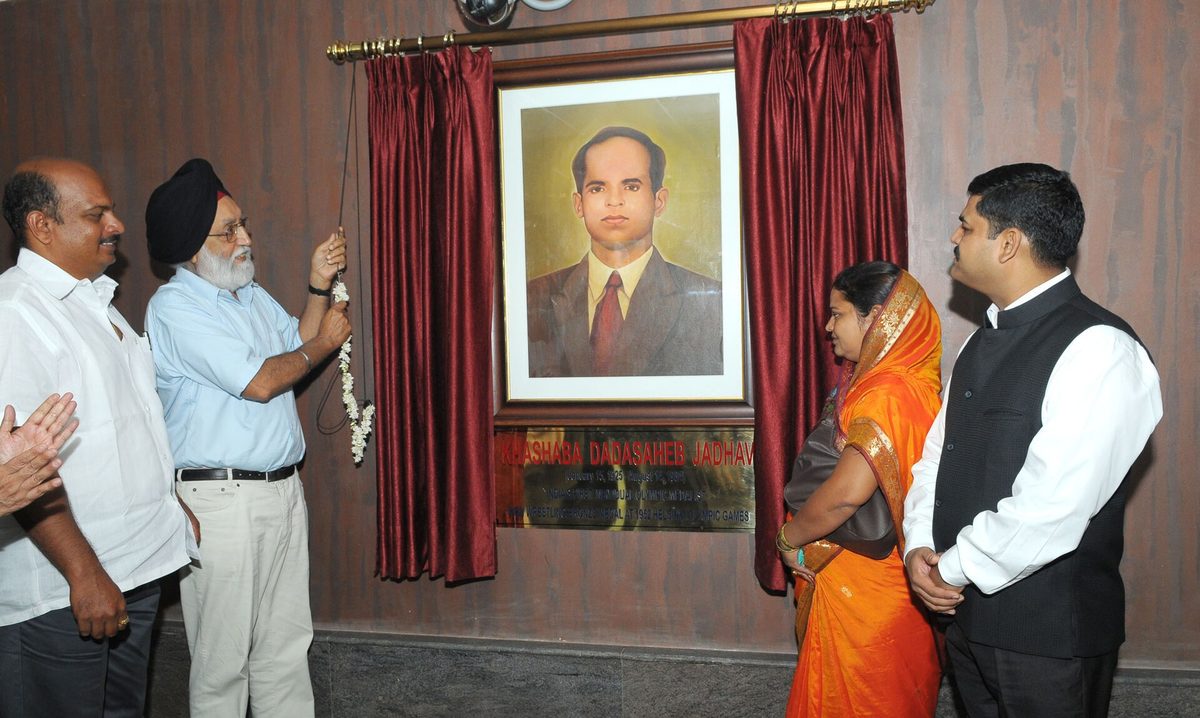
| 2010 | K. D. Jadhav Indoor Hall, New Delhi | The Commonwealth Games wrestling venue at the Indira Gandhi Sports Complex renamed in his memory |
| 2023 | Google Doodle | Marking his birth anniversary on 15 January |
The award that never came
Khashaba Jadhav holds a distinction that no one would want. He is widely noted as the only Indian Olympic medallist never to have received a Padma award — the civilian honours routinely conferred on the country's sportspeople.
His family has campaigned for this for decades. At one point the frustration ran deep enough that the auctioning of the 1952 bronze medal itself was publicly raised — a measure of how completely the recognition, and the promised wrestling academy at Goleshwar, had stalled.
The family's long campaign
The neglect did not end with Khashaba. His son, Ranjeet, scored 214 in the Maharashtra Public Service Commission examination — one mark short of the qualifying threshold — and his mother petitioned repeatedly, and unsuccessfully, for his recruitment into the police force his father had served for twenty-seven years. It took the Manohar Joshi state government to finally provide the family ₹1 lakh in assistance and a government post for Ranjeet; in the years before that, agriculture remained the family's main income. Ranjeet later wrote to India's Sports Minister pressing his father's case for the Arjuna Award — eventually conferred, posthumously, in 2000.
Stadiums · Competitions · Academies · Schemes
In His Name
Recognition came late, but it did come — in stadium names, state competitions, academies and honours spread across every level of Indian public life.
The count so far
| Level | Documented | What |
|---|---|---|
| Central Government | 1 | National wrestling stadium, New Delhi |
| State Government (Maharashtra) | 2 | State wrestling cup (scheme since 2012) · Chhatrapati Puraskar (posthumous, 1992–93) |
| Maharashtra Police | 1 | Sports ground and lane, Police Naigaum, Mumbai |
| National honours | 1 | Arjuna Award (posthumous, 2000) |
| District & village | 2 | Statue and memorial at Goleshwar · sanctioned Goleshwar academy site |
| Private institutions | 2 | Sports academy at Karad · feature film (2027) |
| NGO | 1 | Kusteeveer Khashaba Jadhav Foundation (2024) |
| Global / digital | 1 | Google Doodle (2023) |
Counts reflect entries this archive has verified against a published source, not a claim of completeness — many akhadas, gymnasiums and local kusti maidans across Maharashtra also carry his name and are being catalogued.
Central Government
K. D. Jadhav Wrestling Stadium, New Delhi
In 2010, the newly constructed wrestling stadium inside the Indira Gandhi Sports Complex — built for the XIX Commonwealth Games — was named the K. D. Jadhav Wrestling Stadium in his memory, with the plaque unveiled by the Union Minister of Youth Affairs and Sports. It remains the premier wrestling venue in the capital, and Indian wrestlers won gold inside it at those same Games.
Reference: Press Information Bureau, Government of India (2010) — “New Wrestling Stadium Named as KD Jadhav Stadium”; pib.gov.in, release ID 63042.
Government of Maharashtra
The Khashaba Jadhav Cup
Since 3 November 2012, the Department of Sports, Government of Maharashtra has run the “Late Khashaba Jadhav Cup State Level Wrestling Competition” as an official scheme — alongside the Chhatrapati Shivaji Maharaj Cup (kabaddi) and Bhai Nerurkar Cup (kho-kho) — to nurture wrestling talent across the state.
- Administered from the Shiv Chhatrapati Sports Complex, Balewadi, Pune.
- Hosted by a different district each edition — recent editions include Udgir (Latur district), with around 360 wrestlers from across Maharashtra, and Beed, approved for a state edition in 2026.
- Gives district-level wrestlers a route to compete alongside state and international-level athletes.
References: Department of Sports, Government of Maharashtra (mahasports.maharashtra.gov.in, scheme dated 03/11/2012); Saamana (Udgir edition report); Dainik Prabhat (Pune selection trials); Tejwarta (Beed 2026 approval).
District, Village & Private
Karad, Goleshwar — and the screen
Khashaba Jadhav Sports Academy, Karad
Established by Shikshan Mandal, Karad — the town's historic educational trust — offering sports facilities, yoga, exercise, diet guidance and sports psychology, free and open beyond its own institutions.
Reference: Shikshan Mandal Karad (shikshanmandalkarad.com).
The Goleshwar memorial & statue
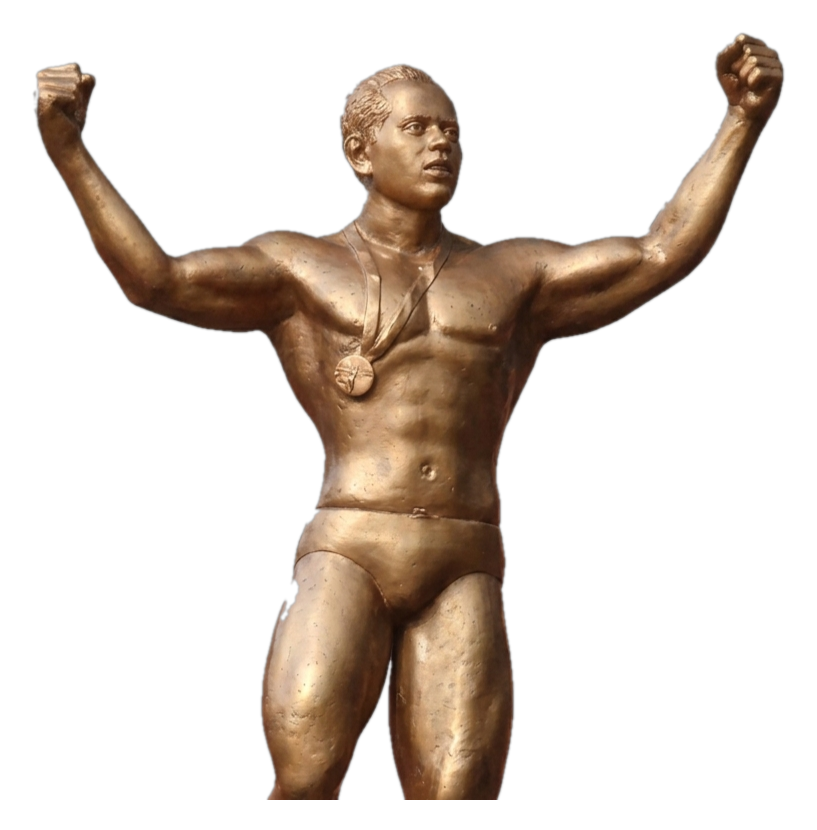
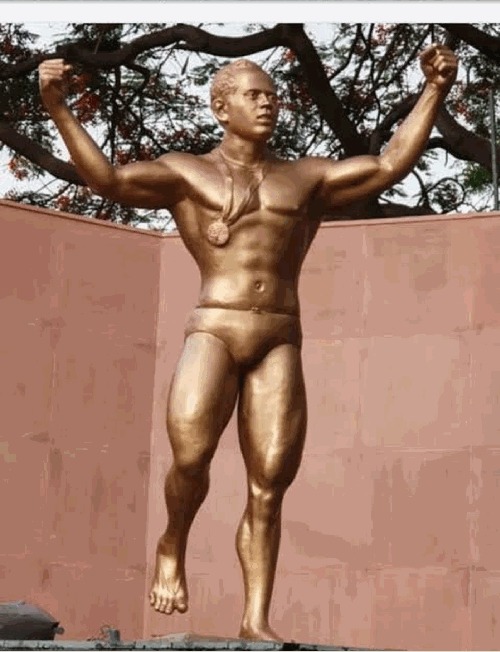
At his village stand his statue — arms lifted in the wrestler's salute, medal at his chest — and Olympic Niwas, his home. Funds for a wrestling academy at Goleshwar were sanctioned in December 2013; completing it is the Foundation's founding mission.
References: Scroll.in (2017, on the academy and medal); Jadhav family archive (statue photograph).
“Khashaba” — the feature film (2027)
Nagraj Manjule's biographical drama, produced by Jio Studios and Aatpat Productions, reaches cinemas worldwide on 1 January 2027 — the largest private-sector tribute yet to carry his name.
Reference: official teaser and production announcements.
Sports Ground, Police Naigaum, Mumbai
A sports ground within the Maharashtra Police's Naigaum premises in Mumbai — where Khashaba served for twenty-seven years — carries his name, as does the lane beside it.
Reference: Rediff.com, “Khashaba Jhadhav, the hero we owe an apology to” (2000).
Kusteeveer Khashaba Jadhav Foundation (2024)
The Section 8 non-profit founded by his family on 13 August 2024 — forty years after his passing — to complete the Goleshwar academy and steward this archive.
Reference: www.khashabafoundation.org (CIN U88900PN2024NPL233550).
Missing from this list?
District kusti tournaments, akhadas, school prizes, vyayamshalas — if it carries Khashaba Jadhav's name and has a citable source, it belongs here.
The Long Wait
India's Individual Olympic Medals
The clearest measure of what Khashaba Jadhav achieved in 1952 is how long it took anyone else to repeat it. He won India's first individual Olympic medal as a free nation. The second did not arrive for forty-four years.
| Year | Athlete | Event | Medal |
|---|---|---|---|
| 1900 | Norman Pritchard | Athletics (200 m, 200 m hurdles) | Silver × 2 — won under the British Raj; status historically debated |
| 1952 | Khashaba Dadasaheb Jadhav | Wrestling, bantamweight freestyle | Bronze — independent India's first individual Olympic medal |
| 1996 | Leander Paes | Tennis, singles | Bronze — the next individual medal, 44 years later |
| 2008 | Sushil Kumar | Wrestling, 66 kg freestyle | Bronze — India's first Olympic wrestling medal since Khashaba |
| 2012 | Sushil Kumar | Wrestling, 66 kg freestyle | Silver — India's first individual two-time Olympic medallist |
| 2012 | Yogeshwar Dutt | Wrestling, 60 kg freestyle | Bronze |
Selected individual medals, to illustrate the gap. India has won further Olympic medals across shooting, boxing, badminton, weightlifting, athletics and hockey.
The Wrestlers Who Followed
Fifty-six years to the next wrestling medal
After Khashaba's bronze in 1952, India did not win another Olympic wrestling medal until Sushil Kumar took bronze at Beijing in 2008 — a gap of fifty-six years. Sushil went on to win silver at London 2012, becoming India's first individual two-time Olympic medallist, and Yogeshwar Dutt took bronze at the same Games.
There is a quiet symmetry in what happened in between. In 2010, the wrestling venue for the Commonwealth Games in New Delhi was renamed the K. D. Jadhav Indoor Hall. India's wrestlers won gold there — competing, at last, in a hall that carried the name of the man who started it all.
He proved it could be done. It then took India forty-four years to do it again — and fifty-six to do it again in his own sport.
Unfinished
What Is Still Owed
The academy at Goleshwar
Khashaba's own ambition was a world-class wrestling academy in his village. Funds were sanctioned in 2013 and the project stalled. Completing it is the founding purpose of the Kusteeveer Khashaba Jadhav Foundation.
National recognition
He remains the only Indian Olympic medallist never awarded a Padma honour. His family has pressed the case for decades.
The record itself
Photographs uncatalogued, footage unlocated, documents undigitised. This archive is an attempt to fix that before the material is lost.
2025
The Centenary Year
On 15 January 2025, the country marked one hundred years since Khashaba Jadhav's birth. The centenary is being carried forward by a Nagraj Manjule feature film on his life, due in cinemas on 1 January 2027, a Foundation newly established in his name, and an archive being built to keep the record straight.
The centenary remains the best chance in a generation to convert remembrance into something durable: a functioning academy, a recognised national honour, and a story that Indian schoolchildren actually know.
What recognition should look like
The Kusteeveer Khashaba Jadhav Foundation takes the position that recognition is not principally about medals and citations. It is about finishing what he started: the academy at Goleshwar, the athletes it would train, and an archive that keeps the record straight.
The Padma award should come. But the more durable memorial is a functioning wrestling academy in the village that once emptied its pockets to send him to Finland.