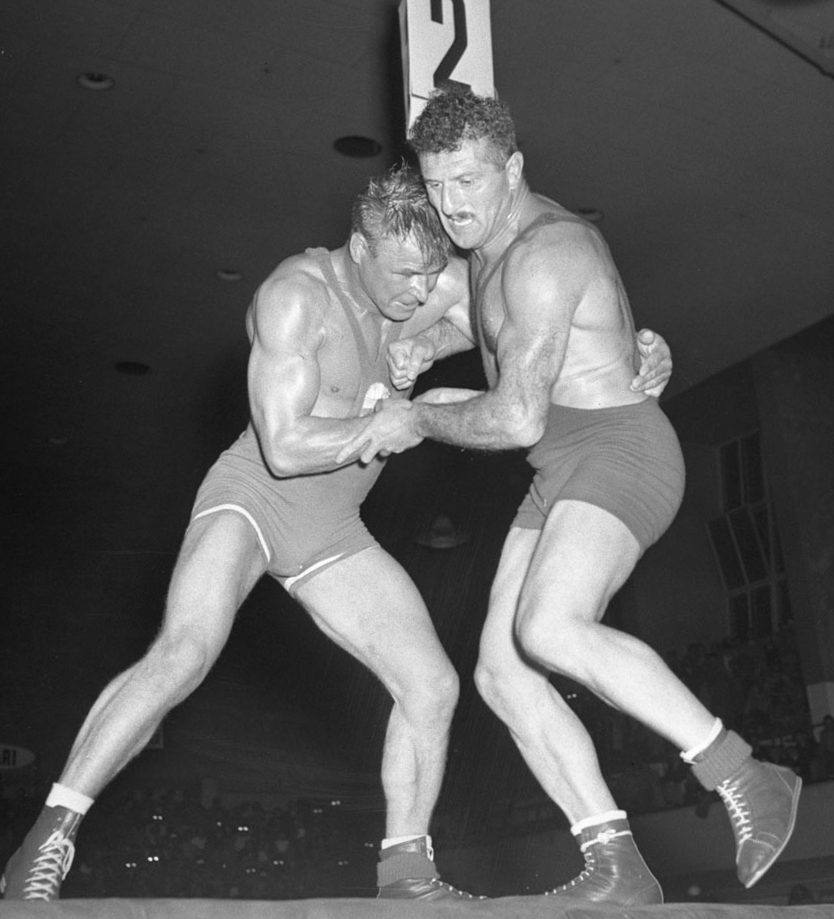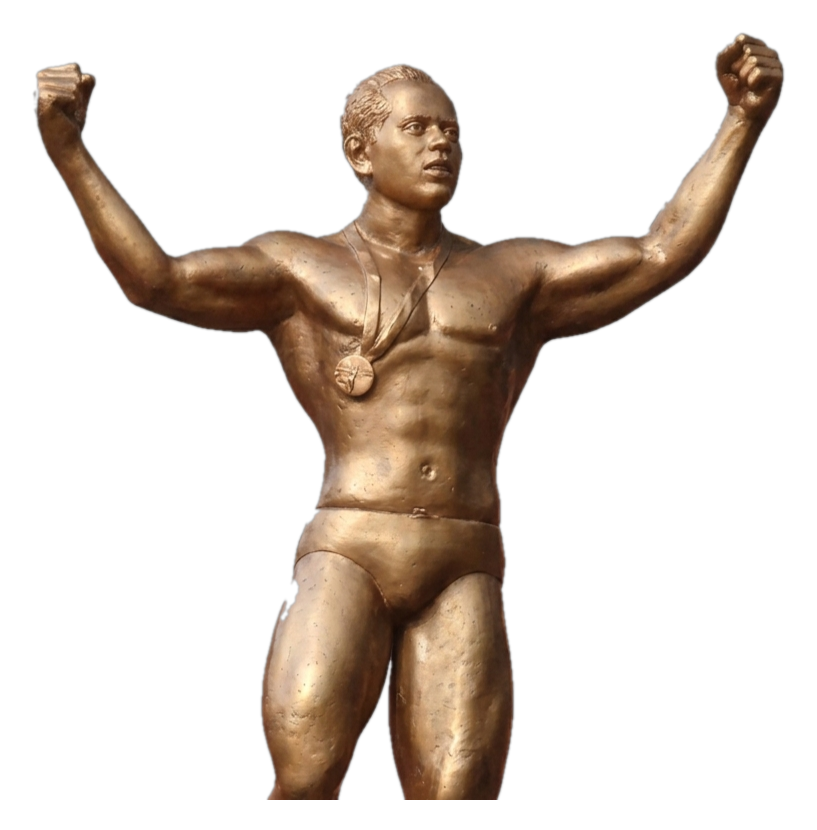
London 1948 · Helsinki 1952
The Olympics
Two Games, four years apart. The first taught him what was possible; the second made history. The complete record of Khashaba Jadhav's Olympic career.
The XIV Olympiad · 1948
London 1948
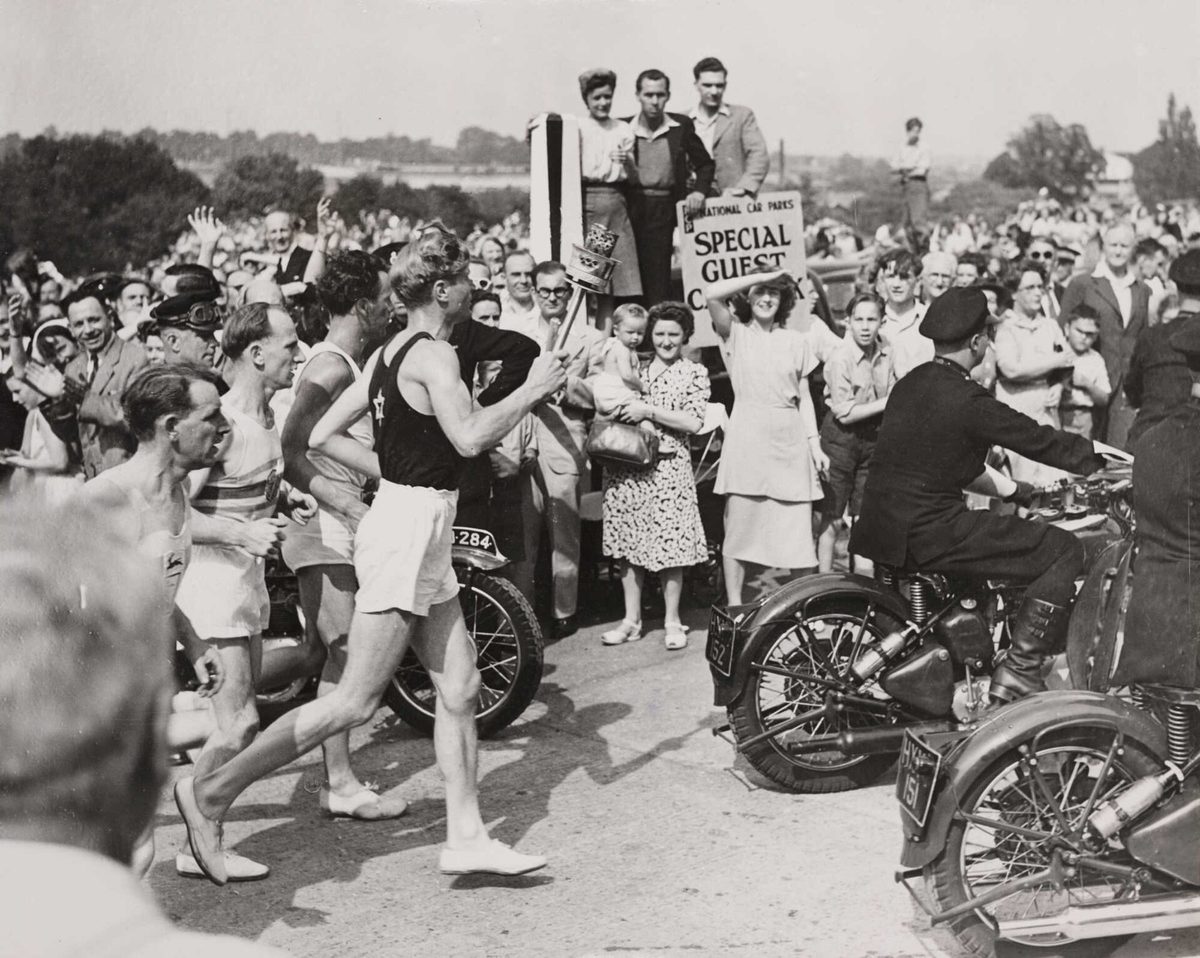
The 1948 London Olympics were the first Games held after the Second World War — a twelve-year gap, and an event so straitened that competitors were asked to bring their own towels and food rations. They are remembered as the “Austerity Olympics.” They were also the first Games at which India competed as an independent nation, less than a year after the transfer of power.
Getting there
Khashaba's selection had been earned in the pit at Lucknow, but selection did not come with money. His passage was financed by Shahaji II, the Maharaja of Kolhapur — the last working expression of the princely patronage system that had built wrestling in the region. In London, Khashaba trained under the English coach Rees Gardner.
Earth versus mat
The single most important fact about Khashaba's 1948 campaign is technical. Indian kusti is contested on soft earth; Olympic freestyle wrestling is contested on a mat. The surfaces reward different footwork, different balance, and completely different approaches to going to ground. Khashaba had spent roughly fifteen years perfecting his craft on one surface, and was now asked to perform on the other, in international competition, with a few weeks' acclimatisation.
The bouts
Competing in the flyweight freestyle division, Khashaba won his opening two bouts and lost his third.
v. Bert Harris (Australia)
WinWon 3–0.
v. Billy Jernigan (United States)
WinWon 3–0.
v. Mansour Raeisi (Iran)
LossLost by technical fall at 5:31, against one of the strongest wrestling nations on earth.
He finished sixth in the world.
What he took home
Sixth place at an Olympic Games would be a career for many athletes. For Khashaba it was a measurement. He had discovered exactly how wide the gap was between himself and the podium, and concluded — correctly — that it was closeable. He spent the next four years closing it, adapting his earth-trained technique to the mat.
What he could not have anticipated was that the political ground beneath him was about to shift. The princely states were being integrated into the Indian Union; Kolhapur's patronage of wrestling, and the Maharaja's purse that had put him on a plane to London, would not be there in 1952.
The XV Olympiad · Context
The 1952 Helsinki Olympics
Khashaba Jadhav's medal did not happen in a vacuum. The 1952 Helsinki Olympics were one of the most politically loaded Games of the twentieth century — the first at which the Cold War's two blocs met in open competition, and the first at which several nations created by the upheavals of the 1940s appeared at all.
The Soviet Union returns
Helsinki 1952 was the Soviet Union's first Olympic Games. A Russian team had last competed in 1912, under the Tsar. The USSR had stayed outside the Olympic movement for four decades, and its entry was the sporting event of the era. It finished second in the overall standings at its first attempt.
Anxiety about Cold War confrontation ran high enough that the Soviet team and the Eastern Bloc nations — Hungary, Poland, Bulgaria, Romania, Czechoslovakia — were housed in a separate Olympic Village from the Western competitors.
For Khashaba this was not an abstraction. The man who beat him in Round 5, Rashid Mammadbeyov, was part of that first Soviet delegation.
New nations, and returning ones
- Israel made its Olympic debut, having been unable to compete in 1948 during its war of independence.
- Japan and Germany returned after being excluded from the 1948 Games as the defeated powers of the Second World War.
Both facts touch Khashaba's story directly: his gold-medal opponent, Shohachi Ishii, became the first Japanese Olympic champion of the post-war era, and his Round 3 opponent, Ferdinand Schmitz, wrestled for a Germany competing for the first time in sixteen years.
India at Helsinki
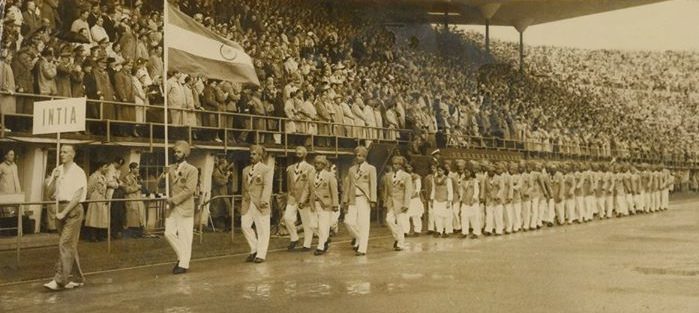
India arrived in Finland as a nation not yet five years independent, and still living with the consequences of Partition. Its Olympic reputation rested almost entirely on the field hockey team, which duly won gold again in 1952 — a magnificent achievement, and a collective one.
What India had never had was an individual Olympic medallist under its own flag. Norman Pritchard had won two silvers at Paris in 1900, but in the era of the British Raj and under circumstances still debated by historians. Khashaba Jadhav's bronze was something categorically new: an Indian competing alone, for a free India, finishing third in the world.
The wrestling
Wrestling at these Games was contested at Messuhalli under the “bad points” elimination system described below. Twenty nations entered the bantamweight freestyle division alone — a measure of how genuinely global, and genuinely competitive, the event was.
In that field, an athlete who had learned his craft on village earth, funded by neighbours, with no team officials present to represent him, finished third.
20 – 23 July 1952 · Messuhalli, Helsinki
Helsinki 1952: The Bouts
The men's freestyle bantamweight competition at the 1952 Olympic Games was held from 20 to 23 July at Messuhalli, the Töölö Sports Hall in Helsinki. Twenty wrestlers from twenty nations entered the 52–57 kg division. One of them was a 26-year-old police-constable's-pay-grade wrestler from Goleshwar who had arrived on borrowed money.
How the competition worked
Olympic wrestling in 1952 did not use a knockout bracket. It used a “bad points” elimination system, and understanding it is essential to understanding what happened to Khashaba:
- A wrestler who won by fall received 0 bad points.
- A wrestler who won on a decision received 1 bad point.
- A wrestler who lost received 3 bad points.
- Accumulate 5 or more bad points and you were eliminated.
The system rewarded dominance: winning by fall cost nothing at all. Khashaba's opening campaign was built precisely on that — he won his first two bouts by fall, carrying zero bad points into the third round.
The Record
Bout by Bout
v. Adrien Poliquin · Canada
Win — FallKhashaba won by fall, in 14:25. No bad points.
v. Leonardo Basurto · Mexico
Win — FallA second win by fall, this one in just 5:20 — a perfect start through two rounds, conceding no bad points.
v. Ferdinand Schmitz · Germany
Win — DecisionWon 3–0 on a decision, taking his first bad point of the competition.
The opponent: Schmitz entered both the freestyle and Greco-Roman bantamweight competitions at Helsinki. He withdrew from the freestyle event after this stage, and went on to finish sixth in the Greco-Roman division. Germany competed at these Games for the first time since the war, represented entirely by West German athletes.
Bye
No boutKhashaba advanced without wrestling as the field thinned.
v. Rashid Mammadbeyov · Soviet Union
Loss — DecisionLost 0–3 on a decision to the eventual silver medallist.
The opponent: Rashid Mammadbeyov (1927–1970) of Baku became the first Olympic medallist of Azerbaijani origin with his silver at these Games. He was coached by Rza Bakhshaliyev, the founder of professional wrestling instruction in Azerbaijan, and had twice finished second at the USSR championships. Helsinki 1952 was the Soviet Union's first Olympic Games.
v. Shohachi Ishii · Japan
Loss — DecisionLost 0–3 to the eventual gold medallist, finishing third overall.
The opponent: Shohachi Ishii (1926–1980) of Tokyo became the first Japanese Olympic champion after the Second World War, and Japan's only gold medallist at the 1952 Games. He had taken up wrestling only because there was no judo club near him. Widely told accounts of Khashaba's Games hold that their bout ran a punishing fifteen minutes and was decided by a single point.
Sources differ, however, on the order of those final two bouts. The official round-by-round record lists Round 5 against Mammadbeyov and then the medal-round bout against Ishii, as set out above; several popular accounts reverse them, placing the Ishii bout first. This archive presents the official sequence, and notes the discrepancy rather than resolving it by preference. What both versions agree on is the substance: a wrestler at the outer edge of exhaustion, with no one in his corner to protect his entitlement to rest.
The Result
Final Standings — Bantamweight Freestyle
| Position | Wrestler | Nation |
|---|---|---|
| Gold | Shohachi Ishii | Japan |
| Silver | Rashid Mammadbeyov | Soviet Union |
| Bronze | Khashaba Dadasaheb Jadhav | India |
Only two men in the world finished ahead of him, and both of them beat him on decisions rather than falls. On 23 July 1952, Khashaba Dadasaheb Jadhav became the first athlete of independent India to win an individual Olympic medal.
It would be forty-four years before another Indian won an individual Olympic medal.